Advertise With Us
Florida Criminal Defense
Targeted legal advertising to
Florida criminal defense audiences
Case Wins






Sponsored Content
This slot is available for advertising
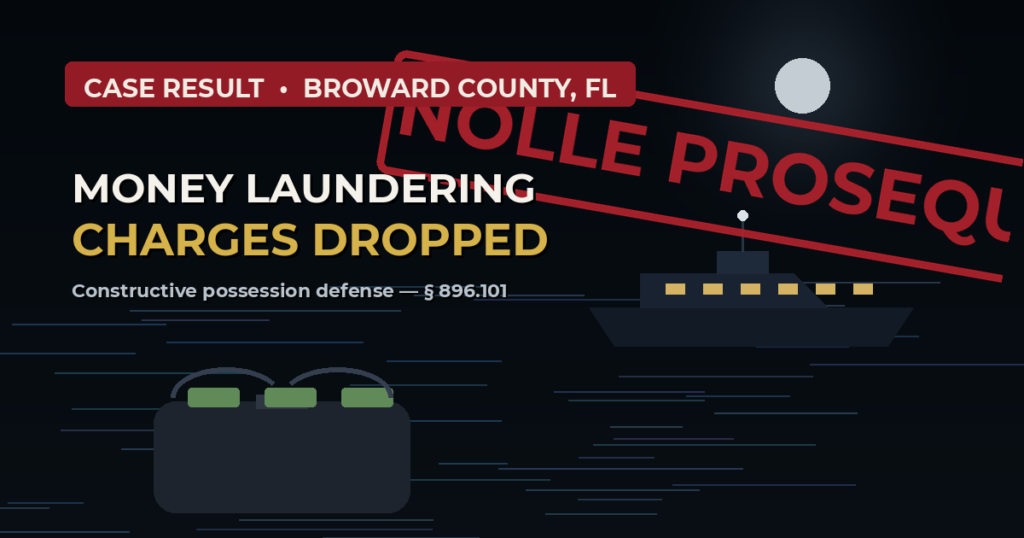
FORT LAUDERDALE — In the bright, salt-heavy glare outside the Broward County Judicial Complex on Southeast 6th Street, private criminal defense attorney Gabriel Stone unzipped his trial satchel, stepped to the shade of the plaza awning, and shook hands with Captain Jesse Ward. The money laundering charges dropped that morning ended an eight-month maritime prosecution.
Minutes earlier, inside Courtroom 16150 before Seventeenth Judicial Circuit Judge Michael A. Robinson, the State Attorney’s Office formally abandoned its prosecution, filing an outright nolle prosequi dismissing all felony counts against the 42-year-old charter captain.
The dismissal marked the collapse of an eight-month state prosecution that threatened Ward with up to thirty years in state prison, placed his commercial mariner’s credentials in jeopardy, and thrust his boutique charter operation into the center of a South Florida money laundering sting.
Ward, a licensed master captain who spent over fifteen years running luxury day excursions along the Intracoastal Waterway and outer reefs, had been booked into the Broward County Main Jail on felony charges under Florida Statutes § 896.101—the Florida Money Laundering Act—alongside charges under Florida Statutes § 893.1351(1) for intentional facilitation of contraband. Under Florida sentencing guidelines, the first-degree felony charges carried mandatory minimum state prison terms and severe financial penalties.
The arrest stemmed from an interagency interdiction off the entrance of Port Everglades, where state marine patrol officers and regional narcotics task force investigators seized two commercial nylon duffel bags stuffed with $480,000 in banded currency from a forward stateroom locker.
An Interdiction on the Waterway The incident began on a Saturday evening in November. Ward had docked his 48-foot Sea Ray Sundancer, Reel Ambition, at a transient slip near the Bahia Mar Yachting Center along Seabreeze Boulevard.
According to state investigative affidavits, the vessel was chartered for a sunset coastal cruise by an intermediary operating through an online yacht-brokerage platform based in Miami. Three male passengers boarded the vessel carrying soft-sided athletic bags, paid the broker fee and fuel surcharge in advance via verified electronic transfer, and presented digital boarding passes matching booking manifests.
As the vessel exited the federal navigation channel past the 17th Street Causeway into open water, two Florida Fish and Wildlife Conservation Commission patrol boats, accompanied by a Broward Sheriff’s Office tactical vessel, intercepted the yacht for what officers initially termed a “routine vessel safety and registration inspection.”
Once aboard, officers claimed they detected the odor of raw cannabis emanating from below deck. Bypassing standard safety gear checks, task force detectives directed a canine unit into the forward cabin, locating the hidden duffel bags stuffed with vacuum-sealed stacks of hundred-dollar bills inside an unlocked under-berth storage compartment.
The three charter passengers immediately invoked their right to counsel and refused to claim ownership of the luggage. Law enforcement promptly arrested the passengers—and placed Captain Ward in handcuffs alongside them.
In their charging documents, prosecutors alleged that as captain and owner of the vessel, Ward exercised exclusive dominion and operational control over the yacht. The state claimed his failure to inspect passenger luggage constituted willful blindness, rendering him a co-conspirator in a systematic money laundering operation.
The Problem of Constructive Possession To Ward, the arrest was an absurd distortion of commercial maritime reality.
“I run a professional charter business, not a private airport screening terminal,” Ward said following the court hearing. “I don’t have the legal authority to search a charter guest’s private duffel bags without their consent, nor does maritime regulations expect charter captains to act as TSA agents. The broker took the deposit, the passengers boarded with luggage, and within an hour I was facing thirty years.”
Recognizing the existential threat to his freedom, Ward hired Stone, a veteran private criminal defense attorney and partner at Stone, Alvarez & Sterling on Southeast 3rd Avenue.
“The State attempted to manufacture a felony conviction out of pure constructive possession,” Stone said outside the courthouse. “Under Florida law, merely being the captain of a vessel or the driver of a vehicle where third-party contraband is located does not make you a felon. Law enforcement assumed that because Jesse was in charge of the boat’s navigation, he was legally responsible for every private item inside his passengers’ personal luggage. That is not the law in Florida.”
Under Florida case law, when an accused is not in exclusive, personal possession of the specific location where contraband is recovered—such as a common-area compartment or a chartered cabin accessible to multiple passengers—the state cannot presume knowledge. The prosecution must provide independent, corroborating evidence establishing that the defendant had actual knowledge of the illicit nature of the cargo and exercised conscious dominion over it.
Stone immediately filed a motion for an evidentiary hearing and moved to suppress the evidence seized during the boarding, attacking both the pretext of the initial stop and the total absence of evidence connecting Ward to the funds.
Metadata, Manifests, and the Broker’s Trail During pretrial depositions, Stone conducted a rigorous cross-examination of the lead task force detective.
Under questioning, the detective conceded that wiretap intercepts and surveillance logs monitoring the underlying financial conspiracy never once mentioned Jesse Ward, his vessel, or his maritime LLC. Furthermore, forensic extraction from the passenger cellphones revealed encrypted messaging threads coordinating the movement of the currency exclusively among the charter guests, who explicitly referred to the captain as an “unwitting civilian charter.”
Stone followed by introducing the verified digital records from the yacht booking platform.
The brokerage audit trail established that the reservation was made anonymously using a corporate debit card, with no direct communication ever taking place between the suspects and Ward prior to dockside boarding. The contract explicitly stipulated that Ward was providing bare navigational services under a standard USCG bareboat charter agreement, with the passengers designated as charterers exercising temporary possession of the cabin space.
“The statutory structure of Florida Statute § 896.101 requires proof beyond a reasonable doubt that the accused acted with specific financial knowledge—knowing that the property involved represents the proceeds of unlawful activity,” Stone argued during the hearing. “The state could not point to a single fingerprint, a single text message, or a single shred of forensic evidence linking Captain Ward to those duffel bags. Not only did he not know what was in the bags; he was barred by civil contract from rifling through them.”
Stone additionally presented dashcam and body-worn camera footage from the initial boarding, showing that the officers bypassed standard life-jacket and flare inspections entirely, using the regulatory stop as an unconstitutional pretext to execute a warrantless search without probable cause or valid consent.
Dismissal on the Record Confronted with the digital booking logs, the wiretap transcripts clearing Ward, and the looming likelihood that the court would suppress the fruits of the vessel search under the Fourth Amendment, Assistant State Attorney Daniel Ross conceded in open court that the prosecution lacked sufficient evidence to carry its burden at trial.
Standing before Judge Robinson, Ross formally announced that the State was declining further prosecution, entering a formal nolle prosequi dismissing all charges against Ward.
Judge Robinson approved the dismissal, vacating all bond restrictions and ordering the immediate return of Ward’s passport and maritime credentials.
“The criminal justice system cannot be permitted to transform commercial service providers into criminal scapegoats,” Stone stated outside the Broward County Judicial Complex. “When law enforcement conducts broad-brush maritime interdictions, they often treat everyone on board as an organized cartel. It requires meticulous private defense work—dissecting the manifests, subpoenas, and statutory definitions of possession—to force the State to acknowledge the difference between a smuggler and a working captain doing his job.”
For Ward, the conclusion of the case represents a hard-won vindication, though the journey to recover his reputation is only beginning. Stone confirmed that their office has already prepared petitions to clear Ward’s arrest record through the Florida Department of Law Enforcement and will initiate proceedings to release the administrative seizure on his vessel.
“I spent eight months unable to work, with my livelihood tied to a dock and my name tied to a drug ring,” Ward said as he looked down toward the New River. “If Mr. Stone hadn’t forced the prosecutors to look at the digital paperwork and prove I had nothing to do with those men, I would have lost everything I spent fifteen years building.”
Disclaimer: Content reflects possible scenarios for defendants and not necessarily guarantee.
Support Florida Criminal Defense
This educational resource is supported by local advertisers
Interested in reaching our audience?
Learn About Advertisingadvertise@floridacriminaldefense.us