Advertise With Us
Florida Criminal Defense
Targeted legal advertising to
Florida criminal defense audiences
Case Wins

Sponsored Content
This slot is available for advertising
JACKSONVILLE — Stepping into the humid afternoon glare outside the Duval County Courthouse on West Adams Street, private criminal defense attorney Christian Vance closed his trial binder and clasped the shoulder of Michael Thompson. The organized fraud acquittal moments earlier ended a ten-month felony prosecution.
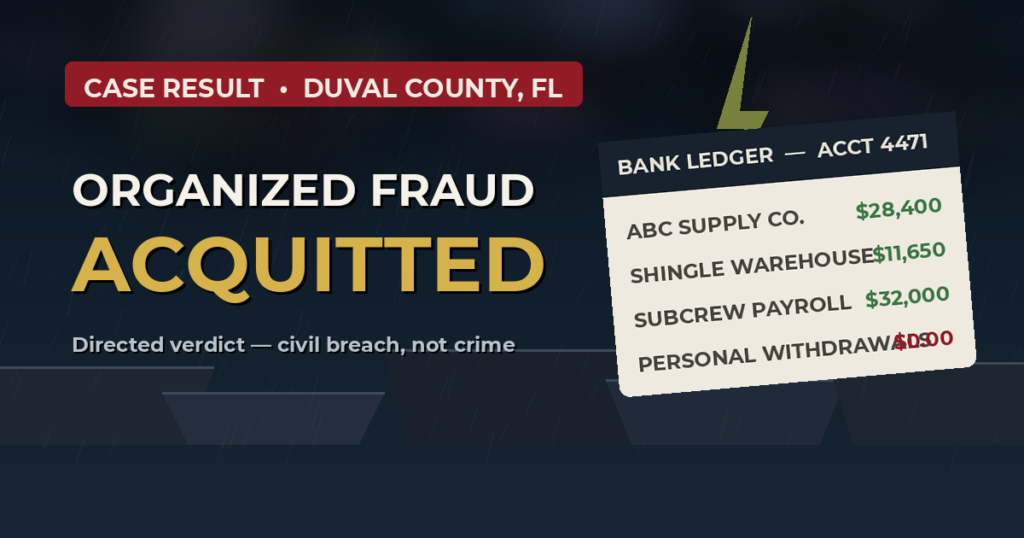
Inside Courtroom 504 of the Fourth Judicial Circuit, Circuit Judge Mark Borello had just delivered a directed verdict of acquittal, dismissing all felony counts of organized fraud against the 47-year-old roofing contractor.
The ruling concluded a grueling ten-month criminal ordeal that threatened Thompson with up to fifteen years in state prison, devastated his decade-old business, Thompson Roofing Solutions, and highlighted how post-storm supply chain collapse can be hastily conflated with criminal theft.
Thompson had been arrested by the Jacksonville Sheriff’s Office following a wave of complaints from homeowners across Duval County in the wake of severe hurricane damage. Booked into the John E. Goode Pre-Trial Detention Facility, he was charged under Florida Statutes § 817.034(4)(a)(2)—Organized Fraud of $20,000 or more, a second-degree felony under the Florida Communications Fraud Act carrying severe penalties and a mandatory Level 5 ranking on the state sentencing guidelines scoresheet.
The Storm and the Scapegoat The criminal investigation gathered momentum after several property owners in historic Jacksonville neighborhoods, including San Marco, Riverside, and Ortega, reported paying advance deposits between $2,500 and $6,000 for emergency roof tarping and shingle replacements that were never completed.
Among the complaining witnesses was Riverside resident Sarah Martinez, whose home suffered significant wind damage along St. Johns Avenue.
“We were desperate to get our roof secured before the next squall,” Martinez testified during the prosecution’s case-in-chief. “We trusted Thompson because he was an established local contractor with positive community reviews. When the crew vanished and the job sat untouched for weeks, we felt abandoned. It felt like we were robbed.”
Frustrated homeowners took to neighborhood social media groups and message boards, sharing screenshots of unanswered text messages and unreturned phone calls. The narrative gained viral traction, prompting local code compliance officers and detectives with the Jacksonville Sheriff’s Office Financial Crimes Unit to build an organized scheme-to-defraud case based on the aggregate total of unfulfilled consumer contracts.
To law enforcement and the State Attorney’s Office, the pattern seemed straightforward: advance deposits collected, labor neglected, and customer communications dropped.
Assistant State Attorney Karen Holt argued during opening statements that Thompson had orchestrated a classic contractor confidence game. “Poor business administration cannot be used as an umbrella to shield an individual from criminal liability,” Holt argued. “The evidence shows a calculated pattern of soliciting deposits across Duval County with full knowledge that the work would never be performed. Under Section 817.034, that systematic course of conduct constitutes organized fraud.”
Dismantling the Element of Intent Unlike civil litigation over breach of contract, Florida Statutes § 817.034 requires the State to prove beyond a reasonable doubt that the accused engaged in an ongoing, systematic course of conduct with specific criminal intent to defraud consumers through false pretenses or willful misrepresentations.
Facing an aggressive prosecution and an initial state plea offer demanding state prison time and tens of thousands in punitive restitution, Thompson retained Vance, a partner at Vance & Montgomery Criminal Defense — the kind of private criminal defense counsel post-Storm contractors rely on — on Ocean Street.
“The criminal justice system is frequently misused as a collection agency for frustrated civil litigants,” Vance said on the courthouse steps. “When a business hits an operational wall after a natural disaster, consumers feel cheated, and police often mistake financial failure for felonious intent. But Florida law does not criminalize a failed commercial venture or an honest contractor whose supply chain gets severed. To sustain a felony under 817.034, the state must prove criminal fraud existed at the exact moment money changed hands.”
Rather than waiting for a jury to weigh emotional testimony from affected homeowners, Vance launched a forensic financial defense, issuing third-party subpoenas to commercial building supply warehouses and banking institutions across Northeast Florida.
During cross-examination of the lead financial crimes detective, Vance methodically introduced the banking ledger for Thompson Roofing Solutions.
The defense established that Thompson had not pocketed deposit funds for personal enrichment, luxury purchases, or secret accounts. Instead, wire transfers and cashier’s checks demonstrated that over 85 percent of the deposits collected from San Marco and Riverside homeowners had been forwarded directly to ABC Supply Co. for roofing underlayment and architectural shingles, as well as to an independent subcontracting labor crew hired to manage the massive surge in post-hurricane demand.
The turning point came when Vance submitted sworn deposition transcripts and subpoenaed cell phone records detailing the sudden disappearance of the independent labor subcontractor.
The subcontractor had accepted over $32,000 in material and labor disbursements from Thompson, provided falsified delivery manifests, and subsequently fled the state, leaving three major work sites dormant. When Thompson realized the crew had vanished, his personal attempts to secure alternate crews depleted his commercial operating reserves, plunging his business into insolvency.
“A contractor who intends to swindle clients does not order $40,000 worth of roofing shingles to their addresses,” Vance argued to the court. “A businessman attempting an organized fraud does not maintain continuous commercial general liability insurance, nor does he pull legitimate municipal permits with the City of Jacksonville Building Inspection Division. Mr. Thompson was the victim of a rogue subcontractor and an unmanageable logistics collapse, not a criminal mastermind.”
The Directed Verdict At the close of the State’s case on Wednesday afternoon, Vance moved for a Judgment of Acquittal pursuant to Florida Rule of Criminal Procedure 3.380, asserting that the State had failed to present a prima facie case of felonious intent.
Judge Borello agreed, noting that Florida appellate precedent within the First District Court of Appeal strictly forbids convicting contractors of organized fraud based solely on unfinished work or unreturned phone calls when expenditures toward materials and efforts to perform are documented.
“The State has presented evidence of poor business management, contractual failure, and genuine civil injury to these homeowners,” Judge Borello stated from the bench. “What the State has entirely failed to demonstrate is the requisite criminal intent to defraud at the time of contract execution. The defendant’s financial records reflect legitimate commercial efforts, not a criminal scheme. The court cannot allow a civil breach of contract to be transformed into a second-degree felony.”
With that finding, Judge Borello entered a judgment of acquittal, clearing Thompson of all charges and permanently terminating the felony prosecution.
Outside the courthouse, Thompson embraced his defense attorney with visible emotion as traffic moved along Adams Street.
“For almost a year, I’ve had my name dragged through the mud, lost my livelihood, and faced fifteen years in prison for trying to rebuild our community after a hurricane,” Thompson said. “I always wanted to make every single one of those homeowners whole. If Mr. Vance hadn’t forced the court to trace the real bank statements and pull the material receipts, I would have lost my freedom over a crime I never committed.”
Vance noted that the ruling serves as an important precedent in Florida’s coastal jurisdictions.
“When natural disasters hit, tensions run high, and property owners are under immense stress,” Vance said before departing the courthouse steps. “However, law enforcement cannot simply bypass civil remedies to arrest contractors without evidence of criminal intent. Private defense counsel must hold the State to the strict letter of Florida Statute § 817.034 and defend the constitutional boundary separating civil liability from criminal incarceration.”
Disclaimer: Content reflects possible scenarios for defendants and not necessarily guarantee.
Support Florida Criminal Defense
This educational resource is supported by local advertisers
Interested in reaching our audience?
Learn About Advertisingadvertise@floridacriminaldefense.us