Advertise With Us
Florida Criminal Defense
Targeted legal advertising to
Florida criminal defense audiences
Case Wins
Sponsored Content
This slot is available for advertising
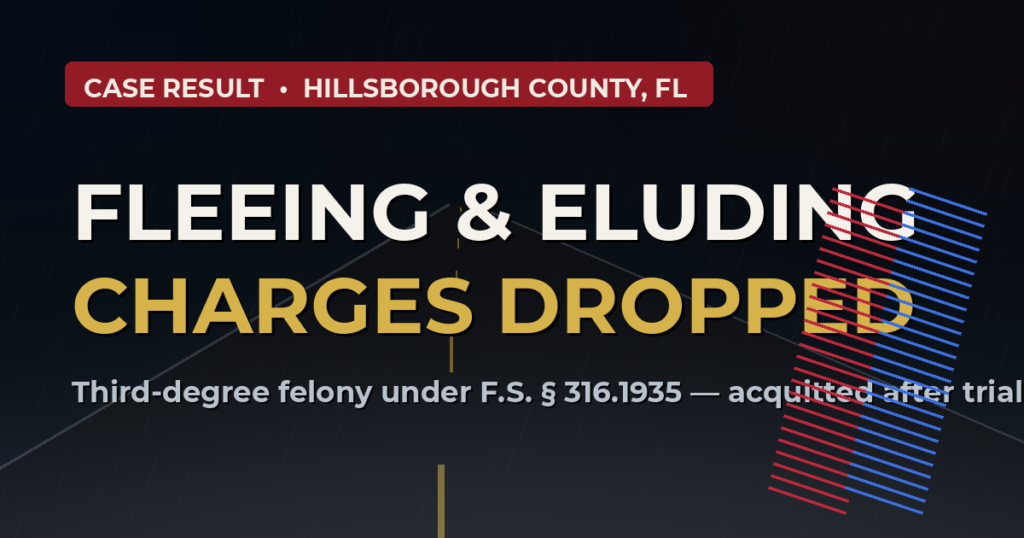
TAMPA — When the blue strobe finally flashed against the side mirrors of his battered 2017 Hyundai Elantra, Julian Vance was precisely ninety seconds behind schedule. The stop would end in a rare fleeing and eluding acquittal.
In the algorithmic calculus of QuickDrop—the on-demand grocery and parcel platform that paid his rent—ninety seconds was the margin between a top-tier driver rating and a punitive platform suspension. Vance was threading his way through torrential summer downpours along the commercial stretch of North Dale Mabry Highway, wiping moisture from the inside of his windshield while trying to decipher turn-by-turn prompts glowing on his dashboard mount.
Ten blocks south, behind a strip mall near West Hillsborough Avenue, a Tampa Police officer had flicked on his emergency equipment.
Vance never saw the cruiser. He did not pull over until he arrived at a well-lit gas station forecourt near Columbus Drive, where he was yanked from his car at gunpoint, thrown to the wet asphalt, and charged under Florida Statutes § 316.1935(1)—fleeing or attempting to elude a law enforcement officer, a third-degree felony punishable by up to five years in state prison.
The fleeing and eluding acquittal at a glance: Charge — felony fleeing or attempting to elude under Florida Statutes § 316.1935(1), a third-degree felony carrying up to five years in prison. Defense — Elena Cruz of Cruz & Sterling Criminal Defense. Verdict — not guilty on all counts after a three-day bench trial in Hillsborough County.
On Tuesday afternoon in Hillsborough County’s 13th Judicial Circuit Court, that charge collapsed entirely.
Following a three-day bench trial before Circuit Judge Eleanor Vance (no relation to the defendant), Julian Vance was acquitted of all charges after his private criminal defense counsel systematically disassembled the state’s narrative, exposing the gap between statutory criminal intent and the disorienting reality of modern gig work.
The Anatomy of an Accusation
According to the initial arrest affidavit filed by Officer Marcus Gable, the incident began just before 9:30 p.m. on June 14. Gable, operating an unmarked Ford Explorer equipped with concealed grille strobes and interior visor-mounted emergency lights, observed Vance’s vehicle fail to maintain a single lane during a sudden squall.
Gable activated his forward emergency lights and followed Vance southward. In his narrative, Gable alleged that Vance made two evasive maneuvers—a sharp lane shift across two lanes of traffic and an abrupt right turn onto an access road—demonstrating a willful refusal to stop.
Under Florida Statute § 316.1935, the burden on prosecutors is exacting: the state must prove beyond a reasonable doubt that the driver knew they were being directed to stop by an authorized law enforcement vehicle displaying active lights and sirens, and that the driver willfully fled or attempted to elude.
The State Attorney’s Office offered Vance a plea deal early in the proceedings: adjudication withheld, two years of felony probation, and a mandatory one-year driver’s license revocation. For a gig worker whose livelihood depends entirely on having a clean driving record, accepting the plea was financial suicide.
“A felony conviction under 316.1935 doesn’t just put you in jail; it strips you of your commercial viability forever,” said Vance’s retained defense attorney, Elena Cruz of Cruz & Sterling Criminal Defense. “The state treated this as an intentional pursuit of a recalcitrant felon. In truth, it was an overwhelmed young man trapped in a mechanical cage of torrential rain, an unmarked vehicle with low-visibility auxiliary lighting, and an automated dispatch system dictating his every movement.”
The Algorithmic Defense
Taking the case to trial, Cruz built her defense around forensic sensor data and platform telemetry rather than mere eyewitness recollection.
During cross-examination, Cruz questioned Officer Gable on the configuration of his patrol vehicle. Under questioning, Gable acknowledged that while his unmarked vehicle was equipped with visor-mounted LED arrays, it lacked the sweeping overhead lightbar typical of marked patrol cruisers. Crucially, Gable admitted that due to the heavy downpour and close proximity to commercial neon signs along Dale Mabry Highway, he had not engaged his siren until Vance was already turning into the gas station.
“Florida law is clear: the vehicle must have prominent, recognizable police insignia and emergency lights, and the motorist must have clear notice,” Cruz argued during opening statements. “An unmarked black SUV sitting forty feet behind in a blinding Tampa thunderstorm does not convey that notice.”
The pivotal moment in the trial came on the second afternoon, when Cruz introduced synchronized telematics from QuickDrop’s driver portal alongside the dashboard dashcam footage recovered from Vance’s car.
Forensic data expert Dr. Keith Mercer testified that the “erratic lane shifts” cited by Gable were not evasive maneuvers, but immediate reactions to platform route updates. QuickDrop’s dispatch algorithm continuously reroutes drivers based on real-time traffic density. At the exact second Officer Gable noted Vance swerving across two lanes, the app had issued an auditory rerouting alert warning Vance that missing the Columbus Drive cutoff would trigger a automatic late-penalty fee.
The dashcam audio corroborated the telemetry: inside the cabin, the radio was off, but the synthetic voice of the app repeatedly shouted navigation instructions over the roar of rain hammering against the roof. Vance could be heard muttering about visibility and the delivery countdown timer.
“The evidence demonstrated zero consciousness of guilt,” Cruz told the court. “There was no acceleration, no weaving between oncoming lanes, no flight. When Mr. Vance finally perceived the vehicle behind him as an officer, he did not run. He pulled into the nearest illuminated, secure commercial apron.”
A Statutory Failure
Under Florida case law, merely failing to immediately pull over does not meet the legal threshold for felony eluding. State precedents hold that the statute requires evidence of an affirmative act of flight or intentional defiance, rather than delayed compliance caused by environmental factors or confusion over vehicle identification.
Assistant State Attorney Bradley Cooper pushed back during closing arguments, arguing that any reasonable driver would have spotted the flashing blue grill lights through their rearview mirror.
“The defendant chose to prioritize a bag of groceries over the authority of a sworn law enforcement officer,” Cooper asserted. “Ignorance of one’s surroundings while operating a motor vehicle on public roads is gross negligence, and ignoring law enforcement lights cannot be excused by an algorithm.”
Judge Eleanor Vance, however, found the state’s argument deficient on the core element of the statute: criminal intent.
“The state has demonstrated that Officer Gable attempted a traffic stop under exceptionally poor weather conditions using an unmarked unit without an active siren,” Judge Vance stated from the bench. “What the state has failed to demonstrate beyond a reasonable doubt is that the defendant acted willfully. Intent cannot be presumed from an obstructed rear view and bad weather.”
With that finding, Judge Vance issued a verdict of not guilty on the felony count of fleeing and eluding, as well as a lesser included charge of reckless driving.
Outside the George E. Edgecomb Courthouse on Twiggs Street following the ruling, Julian Vance stood alongside his defense attorney, visibly exhausted but relieved.
“I was terrified I was going to prison for doing my job,” Vance said, his voice quiet. “When those lights are behind you and you don’t even know it’s a cop until they’re pulling you out of your seat, your entire life flashes in front of you.”
Cruz noted that the case illustrates a growing tension across Florida roadways, where private gig economy contractors operate under relentless pressure while local law enforcement relies increasingly on low-profile, unmarked traffic enforcement vehicles.
“When you criminalize ordinary confusion under heavy statutory penalties, you need private counsel who will dig into the metadata and challenge the baseline assumptions of law enforcement — the kind of preparation described in Florida’s guide to choosing a criminal defense attorney,” Cruz said before departing the courthouse steps. “Today, the statute worked as it was written—not to punish an honest worker, but to demand actual proof of criminal intent.”
Disclaimer: Content reflects possible scenarios for defendants and not necessarily guarantee.
Support Florida Criminal Defense
This educational resource is supported by local advertisers
Interested in reaching our audience?
Learn About Advertisingadvertise@floridacriminaldefense.us