Advertise With Us
Florida Criminal Defense
Targeted legal advertising to
Florida criminal defense audiences
Case Wins

Sponsored Content
This slot is available for advertising
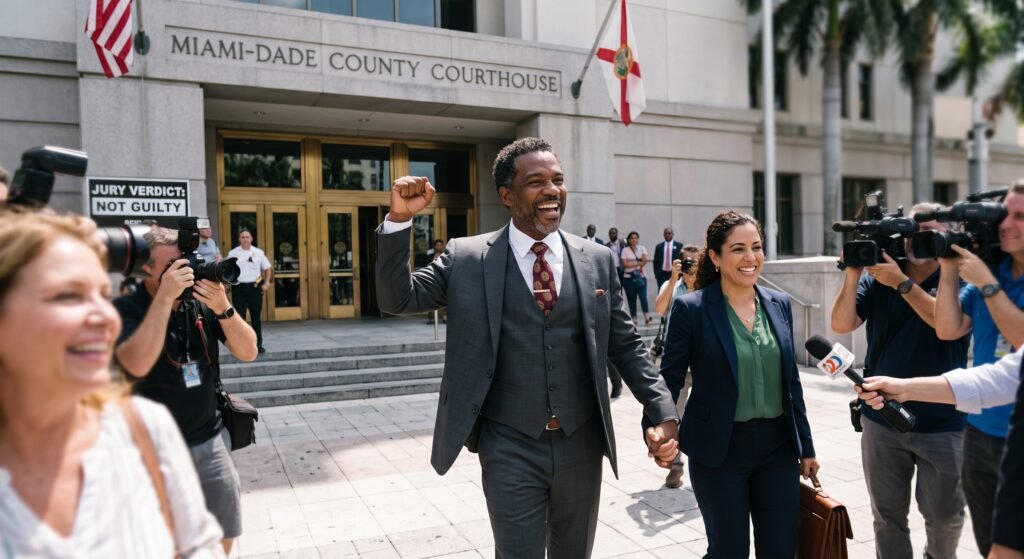
MIAMI, Fla. — A Miami-Dade Circuit Court jury on Tuesday delivered a complete not guilty verdict in the trial of Mateo Cruz, a 34-year-old structural concrete worker who faced life imprisonment for an alleged gangland-style shooting outside a Little Havana nightclub.
The verdict, rendered in the Eleventh Judicial Circuit Court following five hours of deliberation, concluded a contentious two-week trial centered on charges of attempted first-degree premeditated murder with a firearm under Section 782.04(1)(a) and Section 775.087 of the Florida Statutes. Had he been convicted under Florida’s 10-20-Life sentencing statute, Cruz faced a mandatory minimum sentence of 20 years to life in state prison.
Instead, Cruz walked out of the Richard E. Gerstein Justice Building as a free man after his retained private defense counsel, Elena M. Ramos of Ramos Criminal Defense P.A., systematically dismantled the Miami Police Department’s physical evidence, proving to jurors that key ballistics evidence had been handled with extreme negligence or deliberately compromised.
The case originated from a chaotic altercation in the early morning hours of August 14, 2022, outside Club Azúcar, a popular music lounge situated along Southwest 8th Street (Calle Ocho) near 15th Avenue.
According to prosecutors from the Miami-Dade State Attorney’s Office, an argument began inside the venue over an overturned bar table and spilled onto the crowded sidewalk. Prosecutors alleged that Cruz retreated to his parked silver 2018 Honda Civic, retrieved a concealed 9mm semi-automatic pistol, aimed directly at patron Julian Morales, and fired three rounds into an exterior brick pillar, missing Morales by inches.
Responding Miami Police officers detained Cruz two blocks away on Southwest 7th Street within four minutes of the 911 dispatch.
At trial, Assistant State Attorney Victor Hernandez framed the case as a textbook example of street violence fueled by alcohol and premeditation. The state called Morales to the stand, who pointed at Cruz and identified him as the man who pulled the trigger.
Two patrol officers, Officer Rafael Gomez and Officer Hector Velez, took the witness stand to testify that they personally observed Cruz sprint back to his Honda Civic, toss a black polymer handgun into the open center console or glove box, and slam the door shut right before officers drew their service weapons and placed him in zip-ties.
The firearm recovered from that vehicle, a 9mm Taurus G2C was the linchpin of the prosecution’s case. Spent shell casings collected from the Calle Ocho pavement ostensibly matched the firing pin impressions of the weapon.
However, Ramos, a veteran private criminal defense litigator who took over the case shortly after Cruz’s family posted bond, methodically exposed severe discrepancies in the state’s forensic narrative through digital timestamps and independent ballistics testing.
“The State of Florida attempted to lock a working-class father away for the rest of his natural life based on a fabricated evidentiary trail,” Ramos told jurors during a passionate closing argument. “When law enforcement rushes to judgment on a chaotic night on Calle Ocho, truth becomes the first casualty. My client did not shoot that gun. He did not own that gun. And the state’s timeline shows the weapon could not have arrived in that vehicle through lawful, documented police procedure.”
The defense’s turning point came during the cross-examination of the state’s lead crime scene investigator and the introduction of body-worn camera audit logs subpoenaed by Ramos.
Ramos presented synchronized video evidence displaying a 17-minute blind spot in the chain of custody. While Officers Gomez and Velez testified that they secured Cruz’s Honda Civic immediately upon detaining him, their own body camera metadata revealed that both officers remained stationed at the street corner watching other fleeing nightclub patrons. The Honda Civic was left unlocked, unmonitored, and out of frame on a dimly lit side street for over a quarter of an hour before any officer approached the driver’s door.
Ramos then introduced testimony from Dr. Aris Thorne, a private forensic ballistics specialist and former senior crime laboratory analyst with the Florida Department of Law Enforcement (FDLE), whom the defense had retained to conduct macro-photography on the recovered Taurus pistol.
Dr. Thorne testified that high-resolution microscopic imaging revealed the firearm’s serial number plate bore tool marks and micro-abrasions consistent with mechanical re-etching and chemical treating—alterations that took place long after the firearm left the factory floor. More critically, Thorne testified that trace swabs taken from the slide, magazine base, and trigger mechanism showed a total absence of Cruz’s skin cells or latent fingerprints. Instead, the analysis revealed unidentifiable low-copy DNA from at least three unknown male contributors.
“You have a man alleged to have fired three rapid-fire rounds, sprinted two blocks in August humidity, and tossed a firearm into a car—yet not a single skin cell or fingerprint belonging to Mateo Cruz appears on that grip,” Ramos argued to the bench during her motion for a judgment of acquittal. “Meanwhile, the state cannot account for whose hands touched that door or that interior during the 17 minutes their cameras were pointed elsewhere.”
During a blistering cross-examination, Ramos pressed Officer Gomez on his initial field notes, which originally stated the suspect dropped the weapon on the asphalt, directly contradicting his supplemental report filed three days later claiming the firearm was placed inside the vehicle. Gomez admitted under oath that his supplemental report was drafted only after detectives reviewed street surveillance showing Cruz never threw an object to the ground.
When the state rested, Circuit Judge Carlos Alvarez denied the state’s request for jury instructions on lesser-included offenses of aggravated assault with a firearm, as the defense maintained a total denial of possession and identity rather than a justification defense.
After receiving jury instructions on Tuesday afternoon, the panel of six jurors deliberated for five hours before returning to the courtroom with their verdict.
As the court clerk read the words “Not Guilty” on the primary charge of attempted first-degree premeditated murder, and “Not Guilty” on all accompanying vehicular weapons offenses, Cruz buried his face in his hands and wept. Ramos placed an arm around his shoulders as family members gathered in the third row of the gallery let out audible sighs of relief.
Outside the courtroom on the steps of the Gerstein Building, Ramos emphasized the necessity of independent legal representation in complex felony litigation.
“If Mateo Cruz had relied solely on the initial police affidavits without an aggressive, privately funded forensic review of the physical ballistics and digital dispatch feeds, he would be boarding a Department of Corrections bus tonight,” Ramos told reporters. “This verdict is a triumph for accountability. It sends an unmistakable message to the police department that body-camera gaps, contradictory supplemental reports, and unexplained chain-of-custody lapses will not be tolerated in a court of law.”
Morales and prosecutors departed through a private courthouse exit and declined to comment on the verdict.
Cruz, who spent nearly eight months under restrictive pretrial house arrest with a GPS ankle monitor while awaiting trial, embraced his wife and mother before leaving the downtown complex.
“I told the officers from the first second they put the cuffs on me that they had the wrong man,” Cruz said quietly. “Nobody listened until Miss Ramos stepped in and forced them to look at the real evidence. I lost two years of my life to this nightmare. Today, I finally get to go home to my kids.”
The prosecution, led by the Assistant State Attorney, maintained that the officers acted appropriately and that testimony, coupled with the officers’ accounts, was sufficient for a conviction. State’s attorney argued that any irregularities with the firearm’s serial number were irrelevant to its function as a deadly weapon and that the defense was creating reasonable doubt where none existed. “We are disappointed in the verdict but respect the jury’s decision,” he stated. “We believe the evidence presented showed a reckless and intentional act of violence that endangered the public on a Miami street.”
Legal observers note that the case highlights the growing scrutiny of police evidence procedures in Florida courtrooms, particularly in high-stakes violent crime cases where forensic details are paramount. “Juries are increasingly skeptical of police testimony when it is not perfectly corroborated by unbiased evidence like body cameras,” said a University of Miami law professor, who was not involved in the case. “A crack in the foundation of the state’s evidence chain can be enough to collapse the entire house of cards, regardless of the severity of the charges.”
The not-guilty verdict on the primary charge brings a definitive end to the case against Ruiz, as the jury was not presented with any lesser included charges. The outcome signals that even in serious felony cases, Florida juries are willing to deliver acquittals when the methods of law enforcement are successfully called into question, underscoring a heightened standard for evidence integrity in the criminal justice system.
Disclaimer: Content reflects possible scenarios for defendants and not necessarily guarantee.
Support Florida Criminal Defense
This educational resource is supported by local advertisers
Interested in reaching our audience?
Learn About Advertisingadvertise@floridacriminaldefense.us